Friday, October 15, 2010

Endorsements in California election 2010

This isn't a wine post, though wine does play a part in one endorsement.

I had a hard time voting this year because my local daily, the San Francisco Chronicle, shirked its responsibility. I had to rely on the scraps the Chronicle gave me, superior but non-local endorsements from the Los Angeles Times, and admirably comprehensive coverage from the Bay Guardian, which is way too far left for me.

If you're a California voter, you face the same dilemma. I put some time into my choices and have decided to share my decisions and reasoning.

I'm a registered Democrat but an independent thinker with libertarian leanings. I voted for Schwarzenegger for governor four years ago (I did not vote for the recall) and think he's done a pretty good job; I wish he was running for the Senate. And of course I'm very pro-wine.

Here's how I voted Friday (early, at San Francisco City Hall), and why:

US Senator: Barbara Boxer
The Chronicle refused to endorse a candidate in this race, which spurred me to do this post. I don't have a vocabulary snarky enough to express my disgust with the members of the Chronicle editorial board who are drawing a salary but refused to do their job on the most important race on the ballot. The US Congress might hang in the balance, and the Chronicle expects us to do what, hold our head between our knees and wait for it to end?
To use baseball terms, Boxer is a replacement-level Democrat. She's not a leader or a coalition builder, she's not a great writer of policy, and she doesn't seem all that bright. She offers a reliable party-line vote, which any Democratic functionary could do. We could have a better Senator, for sure.
But is it Carly Fiorina? She's smarter than Boxer and a better speaker, although I don't find her policy discussions in depth or compelling. But look at her record: She took over HP when it was a strong company. The stock price fell, thousands were laid off, it's a much weaker company now, and she got a huge payout when she left. She's a "successful businessperson" in the same sense that George W. Bush was; yes, she was in charge of a big business, but that business didn't do very well (unlike Meg Whitman's.) I don't see any reason to reward her for that with a Senate seat.

California Governor: Jerry Brown
About Meg Whitman: This office would have been soooo easy for her to earn on merit. Brown is a retread, party-machine candidate who didn't start campaigning until recently. Whitman spent a lot of her own money campaigning for months beforehand.
But what did she say, when she had our attention? Nothing, except bad things about Brown. I've seen more than 100 TV ads of hers, but I don't know what she stands for.
So we look at the record. Brown was an adequate governor, neither great nor terrible. He was probably the best mayor Oakland has had in decades, and a surprisingly tough-on-crime guy too. He has been a decent attorney general. I don't think I'll get a great governorship from him, but I don't think he'll be awful either. He's a known quantity.
Whitman's a wild card. Ebay was fabulously successful under her. That said, her reputation there was as an autocratic bully, which won't work as Republican governor of a Democratic legislature. And nothing in her campaigning style has countered that impression.
Schwarzenegger tried governing by fiat in his second year, got swatted down by various unions, and retrenched, using a work-with-the-enemy approach. He has years of practice; he's married to the opposition. I don't get the sense that Whitman has ever been forced to work with somebody who disagrees with her, and that's a prerequisite for this job.

Lieutenant Governor: Gavin Newsom
This was my second-hardest decision. Newsom tends to be all talk and no implementation, and it's tempting to reward Abel Maldonado for risking condemnation by his own Republican Party to get a budget bill passed.
Ultimately, I let wine be my guide. Newsom is a wine lover who once owned a wine shop and co-owns a winery, Cade, that is a leader in environmental responsibility. Besides, this job is all talk and no implementation.

Attorney General: Kamala Harris
This is the most interesting race on the ballot, between Harris, the San Francisco DA, and Steve Cooley, the DA in LA. The SF Chronicle and LA Times both wrote convincing endorsements for their local candidate.
To summarize, Cooley is by far a better manager, while Harris is an idea person who wants the state to address its high recidivism rate.
Some have tried to make this election about the death penalty, which Harris opposes (I'm pro-death penalty). That's focusing on a far less important issue than the one Harris is correctly talking about: We are imprisoning too many people for too long, and we simply can't afford it.
One of the biggest problems about combining crime and punishment with politics is that it's easy to win political points with "toughness." Unless we're going to give someone the death penalty or a life sentence, they're going to get out sometime, and after several years in the overcrowded hellhole of California prisons, with no rehabilitation services to speak of and no re-introduction, they're going to rob us again.
We need a more pragmatic system, with as many offenders as possible in home detention, paying for their own food and shelter, and possibly taking community college classes online so they don't have to commit crimes to support themselves.
Either of these candidates would do a good job. Cooley, frankly, would probably be better for the next four years. But we desperately need a huge philosophical change in the way we view the prison system, and maybe Harris can start to make it.

State Superintendent of Public Instruction: Larry Aceves
Another fascinating choice, this time non-partisan, between a career politician with teaching experience and a career educator. The LA Times swayed me with this endorsement.

Insurance Commissioner: Mike Villines
The Chronicle won me over with this endorsement, which suggests rewarding this Republican for his independence. Makes me wonder where the person who wrote that was when it came time to make a choice for the Senate.

US Representative: Nancy Pelosi
I wish she had used the power of her office to get us some federal goodies for the city, other than that stupid curving train line from Chinatown to the ballpark. But there's no real other choice here.

Secretary of State, Controller, Treasurer, Board of Equalization member: I voted for the Democratic incumbents. If they had been screwing up, we would have heard about it.

State Propositions:
19 Legalizing marijuana: YES
Of course it's a Yes! It's not perfect legislation, and the Feds can still impose federal law. But come on, in 21st century California, nobody should be in prison for growing, owning or smoking marijuana. We don't have the prison space. And we could use the tax dollars from what would instantly surpass wine grapes as a cash crop. We don't get many chances in a lifetime to vote for paradigm-shifting legislation; this is one.
Addendum: The Obama administration, through US Attorney General Eric Holder, has issued fightin' words about this proposition.
Shame on you, Eric Holder. I thought your boss represented democracy. And what happened to "change"? You're taking the same stance as J. Edgar Hoover.
This proposition allows Californians to send a message about whether or not we think marijuana possession should be a crime. The Obama administration is trying to intimidate us into saying something that we don't believe.
Ignore the eventual outcome for a moment; that will take years to shake out. Ask yourself that basic question, because voters might not in our lifetime get another chance to answer it. A Yes vote will lead to more legislation; a No vote ends the debate.
My response to Eric Holder: Yes We Can.

20 Redistricting congressional district: YES
The only good argument against this is that if you're a Democrat, it lessens the party's power in gerrymandering. Bad argument: If Democrats have the numbers, they'll win majorities anyway, and if they don't, they shouldn't.

21 Vehicle license surcharge for state parks: NO
This type of ballot measure is why this state's finances are screwed up. Voters should not micromanage where our tax dollars go; what if there's a crisis, but we can't touch this money? That's why we elect representatives. I wish I could vote for a ballot measure that would outlaw this kind of ballot measure.

22 Prohibits state from borrowing funds from local governments: NO
See 21

23 Suspends air pollution control law: NO
A cynical initiative funded by polluters to get out of complying with a well-written, necessary law.

24 Repeals legislation regarding business tax liability: NO
See 23

25 Allows budget to pass with simple majority: YES
This is the most important ballot initiative. The state is paralyzed every year in passing a budget because of the 2/3 vote requirement. It just doesn't work; we have to change it. Please, if you ignore me on every other endorsement, vote Yes on this. I'm begging you.

26 Requires 2/3 vote for fees: NO
Hello, state budget crisis here. This is going to make it worse, not better.

27 Eliminates state redistricting commission: NO
See 20

Judicial races: The interesting one is for Superior Court Seat #15 between Richard Ulmer, recently seated, and Michael Nava, running against him.
This is another important election The Chronicle wimped out on, leaving me to parse the Bay Guardian's reasoning. (My sincere thanks to the Guardian for doing the most legwork.)
There are two issues here. Where do you stand philosophically? Nava is more liberal. And, do you think a sitting judge who hasn't screwed up should be unseated?
I'm not sure where I stand with these guys on issue #1; I believe I'm between the two of them. But I don't like judges running for office at all, and think contested elections for judgeships are a terrible idea. We want judges independent, not pandering for votes. Unless you're really, really liberal, I think you should vote for Ulmer, even if he's more conservative than you want.
I never know how to vote in the other judgeship elections. I don't like to vote Yes for somebody I know nothing about. The LA Times recommended Yes votes for the Supreme Court candidates, and that's good enough for me. I had a fit of snark in the voting booth Friday and voted No on all the associate justices, figuring that if somebody wanted to mount a last-minute recall campaign, they could use my vote. I don't have the information to seriously recommend a vote one way or the other, and for that I blame my local papers, including the Bay Guardian.

State Assembly: Tom Ammiano
He's further left than I like, but he's earnest and hard-working and will respectably represent his constituency.

Board of Education: Again The Chronicle let me down, leaving me with the Bay Guardian, which is far to the left of how I feel about education.
I parsed the Guardian's reasoning and read this non-judgmental Chronicle story, and voted for Natasha Hoehn, Margaret Brodkin and Hydra Mendoza.

Board of Supervisors, District 8: The biggest issue for SF supervisors is trying to get grownups who will act responsibly about governing the city. When Willie Brown was Da Mayor, I found the childish leftists on the Board amusing and not a terrible counterweight to his amoral backroom dealings. But with Newsom as Mayor, somebody has to be the grownup in this city, which is why I was generally happy with termed-out Bevan Dufty.
I can't trust either the Chronicle -- way too suburban -- or the Guardian -- way too unrealistic -- for Board of Supes recommendations.
I voted Scott Wiener first, followed by Rebecca Prozan. I didn't vote for Rafael Mandelman because he sounds a little too Daly for me. For some, that's an endorsement.

San Francisco measures:
AA $10 additional auto registration for transit: YES
It's not that much money, and we have a ways to go in improving transportation in this city.

A Earthquake retrofit bonds: YES
I don't know what the argument against this would be.

B Requires city employees to pay more for health care: YES
Hell yes! The rest of us are paying more for health care, why does the guy who gives me a traffic ticket or processes my library card get a free ride at my expense? Seriously, what's so special about city employees, that they should get unlimited perks?

C Requires mayor to appear at Board of Supes: YES
I don't know if it will make government better. But it won't make anything worse, and it would be fun to watch.

D Allows non-citizens to vote: NO
This is an example of San Francisco being wayyyy too liberal. You want to vote? Become a citizen. If you're not invested enough in this city to pursue citizenship, you don't deserve to make decisions regarding its future.

E Election Day voter registration: NO
It's not a hardship to register ahead of time, but it WILL be a hardship for already registered voters if a bunch of people show up on election day to try to sign up. Don't penalize those of us who are registered already.

F Reduces health board elections: YES
Seriously, I vote every time -- or thought I did -- but I didn't know we had health board elections.

G Changes MUNI payment formula: YES
MUNI drivers are overpaid and unmotivated, and that's the single biggest transit problem in the city. Once again, voters, I ask you: What makes city employees more special than the rest of us?

H Prohibits elected officials from serving on party central committee: NO
This might be unconstitutional. But even if not, I don't get it. Why wouldn't I want my party's leaders to be my party's leaders?

I Allows private parties to pay to open polls on a Saturday: NO
Privately sponsored elections are a slippery slope. Voters who work all week can vote by mail now; that's sufficient.

J Increases hotel tax rate: YES
I vote for this reluctantly, because every city always socks out-of-towners for its own problems. But we gotta get the money somewhere. Sorry, Iowans. At least have a freshly muddled cocktail while you're here.

K Maintains hotel tax rate: NO
The anti-J.

L Prohibits sitting or lying on sidewalk: YES
I'm amused by the loud controversy over this unenforceable law. Care Not Cash -- Gavin Newsom's signature plan from a few years ago -- was a real attempt at legislation to address the homeless problem here. For all the debate over this law, I don't expect it to do anything to decrease the number of homeless on our streets. We still make this city far too attractive for drifters. It's not like the homeless ever spend any real time in jail anyway; this just gives cops a tool to make them move along. But I'm OK with that. Maybe if we make them keep moving from the best begging corners, they'll decide to go to Portland for a while. I hear Portland's real nice.

M Requires police foot patrol: NO
Does this city have the money for this? Foot patrols are generally a good idea, but this initiative was written for the wrong reason, as the anti-L. Maybe in another election it would be worth talking about, but let's not rush into dictating how police allocate resources as a reaction to something else.

N Increases top-end property transfer tax: YES
We gotta get money from somewhere; sales of buildings over $5 million is a better place than most.

That's it; those are my endorsements. I think the biggest political problem we have in this country is that we don't talk about politics enough, especially with people with whom we disagree. This is my attempt at a civil discussion, and hopefully at actually helping people with a ballot make some hard choices.

Whether you agree with me or not, please vote.

Thursday, October 14, 2010

How corporate executives taste wine

Top corporate executives don't think like the rest of us. A friend who's a management consultant tells me that many real movers and shakers are divorced. They're driven people who don't have the time or inclination for personal lives.

What they do have is money -- piles of it. They have earned luxury and expect it.

I recently watched an instructional video that made me feel a little sorry for these people. You wouldn't think there's a lot of sympathy to be had for people who regularly spend stockholders' (and some taxpayers') money on the most expensive Cabernet on the wine list.

But that's how I felt after watching "Think Like a Genius: Wine Master," starring Master Sommelier Tim Gaiser.

Gaiser isn't the problem. He's earnest, he knows the topic as well as anyone, and he doesn't talk down to the viewer while describing how to taste wine in the most basic of terms.

The shocker is just that: that somebody would spend $49 for a DVD course in learning how to taste. Not learning about the differences between Burgundy and Bordeaux -- but learning to look at the color, sniff the aroma, and sip the wine. In other words, learning to tell the difference between milk and Coca-Cola.

Are corporate executives so inured to sensory input that they're unable to smell lemons in Chardonnay without this video? If so, fortunately there's a workbook with the video so they can measure their progress. Action item!

Of course, just because the San Francisco-based (sigh) Everyday Genius Institute made the video doesn't mean people are actually ordering it. But Gaiser makes his living in large part by teaching corporate classes, so there's obviously a market. And I'm going to give the Institute the benefit of the doubt in knowing the way their audience thinks.

Which is this: wine tasting is a skill to be conquered. An opponent to be vanquished. A merit badge to be earned.

And it puts forward Gaiser as somebody who's better at it than you are: One of the top tasters in the world! "To watch Tim taste wine is like watching magic happen," the chipper Institute CEO says. (If that's true, what would it be like to watch Tim reach ecstasy? Better than doing so yourself?)

The video keeps talking about "goals." What are your goals in tasting? That's pure-corporate speak: no activity is worthwhile in itself.

Yet each time I start to mock the DVD, I realize that it was made by people who know their audience. I have sat at tables with wealthy people who bragged about the inaccessible wines they have in their cellars: "I've got a vertical of Screaming Eagle and a case of 1961 Cheval Blanc." That sort of thing. Invariably they don't offer to open one. And now I know why.

They don't know how to taste it! More to the point -- they think there's a way to taste it, which they haven't mastered yet. Sort of like the black belt of tasting. And if they work hard enough, eventually they'll earn that black belt and be able to kick my ass under the table with their awesome tasting prowess.

Well, if you're a CEO and you're reading this, it's true. There is a way to taste wine. And you're doing it wrong.

I learned the way while living in Japan, on a monastic tasting retreat. We wore nothing but loincloths in January and bathed in the cold rivers each morning at dawn. We did calisthenics, chanted and meditated. And then, The Master showed us the way, if he felt we were worthy of the lesson. Only after a week of fasting were we trusted to begin tasting things by ourselves. But I can't tell you what the way is; it cannot be described in the English language.

So you better spend the $49, Sir. And see if you can charge it to taxpayers the way you did with those wines you bought at Auction Napa Valley.

Wednesday, October 13, 2010

An open letter to Washington state voters

Dear Washington State voters:

Do you drink wine, beer or liquor?

If so, you should vote "Yes" on initiative I-1100.

There's a lot of beer-distributor money being spread around Washington to try to confuse you. There's a competing initiative, I-1105, that was written by Washington Beer and Wine Wholesalers to protect their monopoly. And there's a lot of sanctimonious blather on the airwaves right now about health and alcoholism and minors drinking.

You know who's funding that blather? Beer and wine wholesalers. They don't really want Washington residents to stop drinking, or to drink less. What they want is to ensure that they keep getting a 30% cut.

It's hard to blame any company for trying to protect its business model, even if that model is an outdated government-supported monopoly. What gets under my skin is outright lying about intentions. If wholesalers want people to drink less for public-safety reasons, they don't need voters' support: They can simply stop selling beer and wine.

Costco has been the main supporter of I-1100, and it's not doing so out of public interest either. Costco wants to buy wine without a middleman so it can offer lower prices that encourage people to join.

But unless you're one of the 33% of American adults who don't drink, your interests align with Costco's.

Why should you want to pay higher prices for wine, beer and spirits? You could argue that there's some societal benefit in doing so if the premium you're currently paying over prices elsewhere in the country went to the state. That's an ongoing argument in Pennsylvania.

But in fact, that huge percentage you're now paying to beer distributors is going into corporate coffers. And when it is spent on government, it's not used on schools: it's given to your public officials in an open (and often successful) attempt to influence them.

Moreover, Washington is a sophisticated state in just about every way: urban planning, transit issues, and most political debates. And the quality of top Washington wines is second to none.

But your state-run system of liquor shops is an anachronism. It's the kind of nanny-state government expected in places where most citizens aren't well-educated. At least 36 American states believe private businesses, and their employees, are capable of selling liquor responsibly. Do you believe Washingtonians are incapable of doing so?

Don't let money-grubbing beer distributors confuse the issue.

If you don't drink alcohol, at all, go ahead and vote against I-1100. Keep Washington on the level of fellow control states (and intellectual capitals) like Alabama, Idaho, Maine, Mississippi, Montana, New Hampshire, North Carolina, Ohio, Pennsylvania, Utah, Vermont, Virginia and Wyoming.

If you drink alcohol, remember what happened when a nation of voters let sanctimonious arguments get the better of them 100 years ago. Drinkers voted for Prohibition; it couldn't have passed without them.

Vote your own interests. Don't stand with the 33% who teetotal and see your state as Alabama or Utah. Have some pride and confidence in your state.

Vote "yes" on I-1100.

Sincerely yours,
W. Blake Gray

ADDENDUM: Sean Sullivan has done an excellent job of breaking down the bill's actual impacts. His piece, which does not urge a vote one way or the other, is better than mine.

(PS: Drink more Washington wine! Seven Hills, Hedges, Pacific Rim and Chateau Ste Michelle are some of my favorites. But that's a topic for another day.)

Tuesday, October 12, 2010

Ping-pong showdown at Linne Calodo

Matt Trevisan of Linne Calodo is one of Paso Robles' hottest cult winemakers, and has the most interesting personal story I've heard there. He started making wine when he was working as a forklift driver and living out of his car, and sold all of his assets to buy labels and capsules for his first vintage.

But I don't care about all that (though I promise to tell you more about it). I just want to beat him at ping-pong.

Matt, 38, has two tables at his winery and a selection of paddles. He says he plays about 10 games a day. When a ball rolled away under barrels of his fermenting wine, he'd say, "Don't worry, I've got another." And he plays ambidextrously.

What made me think I could take him? I'm no Forrest Gump. In fact, I'm not all that great, and hadn't played a real game in 9 years. But when I had the best job of my life at an Internet 1.0 company -- (free Webvan food deliveries, sushi parties on Fridays) -- I played several games a day against players much better than me, so I'm not intimidated by superior skills.

Matt's a laid-back surfer type from the San Diego area (Escondido), but he does know the mental game. As soon as I showed interest in playing him -- while we were tasting some of his Sticks and Stones Rhone-blend wines, $68 cult items snapped up by his mailing list -- he asked me what my strategy was. What are my best shots. What are my weaknesses.

Matt's winemaking persona is completely different from his ping-pong. Before he would consent to play me, he ran off a list of strict house rules: all serves must be open-handed, no this, no that.

For winemaking, though, his favorite statement is "There are no rules." He says it over and over. He crushes straight into barrels and says he never makes a barrel full of any one grape variety: instead, he fills it about 75% full with one thing, and tops it off with something else, chosen mostly by its pH, but also by taste and feel.

He ends up, a few months after harvest, with 150 barrels of different combinations of Rhone grapes, which he tastes and then figures out how he wants to blend. It's so casual that you'd think he was at one of Paso's stoner-sounding labels, Chronic Cellars or Dark Star. Instead, he regularly scores more than 90 points from the Wine Advocate.

I pointed out this dichotomy and it was the only time he got slightly defensive: not when I asked about his home life or finances or the fact that, for me, his wines could have a little more acid. Matt takes ping-pong way more seriously than he admits.

"I don't have that many rules (for ping-pong)," he insists. "I need them because people come in here and try all kinds of tricks." And Matt usually gambles: if the visitor loses, they have to buy some of his wine, which ain't cheap. Of course, one could say the loser wins, which is probably why he gets so many games going.

I visited him with two sommeliers from Seattle and Matt insisted on giving us lots of barrel samples beforehand. The sommeliers dug it -- they loved the wines -- but I saw battle tactics, and surreptitiously tipped many down the drain, trying to keep my head clear. I did get in a good game of fetch with his dog, whose preferred toy is the rubber bung used to close a barrel (one of his barrels is either oxidizing or has a little dog spit ... just kidding, he has spares.)

Matt wanted to talk about wine ("The estate vineyard is planted to 20 1-acre blocks. It's nightmare farming") and picking ("We do 'gringo picking.' My office staff has to help out.") I was antsy to play; I think he noticed, like a pitcher holding the ball while the batter fidgets.

Finally we got down to business.

Early on the game unfolded in a promising way: I would leave a ball bouncing high, and Matt, anxious for the macho point, would slam it too far and miss the table.

He played to my backhand, which was weak, and my aim was off enough that I couldn't make him cover the whole table. But with his wildness, I was hanging in there, and my serve started to come back.

I led him 16-14, going into his serve, but I melted down like Armando Benitez. Or, he picked it up a notch -- he served five points in a row. I didn't recover; my last serve was a meatball to his forehand, and he put it away. I lost 21-16, gnashing my teeth with the feeling that I could have had this game.

The sommeliers pointed out that, as a gambler, Matt was probably hustling me. He denied it: "My muscles were tight," he said. "Besides, I play better from behind then ahead. I have a problem with losing leads."

To wash the bitter taste of defeat from my mouth, he opened a few more wines. I tended to like the ones he disavowed -- the '06 Sticks and Stones, which he thought had too much acid, was my favorite: raspberry fruit, good spiciness, a cooked-meat gaminess and a pretty bergamot note. The label lists percentages of Grenache, Mourvedre and Syrah but Matt gives that surfer laugh when you ask about them, because with his method of winemaking he can't really be sure. I also loved his 2000 LC Red, made the year before he said he was influenced by Australian Shirazes into making his wines more "flamboyant."

Big, low-acid wines are the stereotype of Paso Robles reds, and it would be shocking for an Old World drinker to hear some of the ways Matt describes wines. About the '06 Sticks and Stones, he said, "It's fine to drink it with food, but it's not going to be as good on its own."

But let's be realistic here: That's how many Americans drink red wines, as stand-alone beverages. At least these wines are very smooth on the palate. Perhaps because they're co-fermented, they're practically seamless.

Jake Kosseff, wine director at Wild Ginger in Seattle, loved Matt's wines, saying, "They've got this beautiful full palate. The midpalate of wine is what makes them hedonistically wonderful. These wines have that in spades. Nothing flies out in one direction or another. There's a subtle interplay of flavors, but there's a lot going on."

And then there's Matt's personal story. He was a college roommate at Cal Poly-San Luis Obispo of Justin Smith of Saxum; Smith's father gave Matt his first winemaking book. Matt liked the area, so when he graduated with a degree in biochemistry, in 1995 he took a job with Justin Winery (no relation) for $1000 a month. "When you're so cheap, people can't fire you," he said.

The job was theoretically forklift driving, but the winery was small and expanding, so he helped plan and build buildings, handled some bulk wine transactions, did cellar work, etc. He started sleeping in his car on late nights, rather than drive home for an hour, and eventually gave up his apartment for a while and lived in it.

In 1997 he took at better-paying job at Wild Horse as a forklift driver, and was disappointed to learn that was all they expected of him: no punchdowns from the DOF ("dork on fork.") He made 20 barrels of wine with Smith because he was bored.

He and Smith started Linne Calodo together; Smith eventually split off into Saxum, where the wines have even higher ratings and higher prices than Matt's. Matt managed to save $4000 by the spring of 2000 but had to spend it all on labels and capsules because nobody would extend credit to the DOF. "What else was I going to do?" he says.

Finances have changed for Matt. For a decade he's been selling 4000 cases of wine, much of it over $50, almost entirely through a mailing list -- which means no distributors or retailers take big chunks of the money. And he saves on labor by doing so much himself. Matt drove his own backhoe while building his new, functionally attractive, wooden winery -- high ceilings with outflow fans reduce his need for air conditioning in Paso's 100-degree summer days.

A few miles away there's a newish winery whose owner made a fortune in investing and casually dropped $60 million of it to build a winery/monument to capitalism. I prefer rooting for guys like Matt.

But I'm not actually rooting for him, not in ping-pong. He's better than me, I acknowledge it. And he plays all the time. And he may have been hustling me.

Nonetheless, I can take him. Maybe I can't beat him 5 out of 9, but in at least one single game, I can take him.

An Open Letter To Matt Trevisan: You may be smiling now, but this isn't over.


Ping-pong photos taken by Stacie Jacob

Friday, October 8, 2010

Hollywood stars talk wine on TV

To date, there's never been a really successful wine show on broadcast television. PBS is about to try a new angle: Hollywood celebrities talking about wine.

I learned Thursday that WNET, the PBS station in New York, is soliciting wine samples for early episodes of the show, which I heard is tentatively called "Wine Talk." The celebrity planned for the pilot is Stanley Tucci, best known recently as Julia Child's husband in "Julie and Julia," but dear to my heart as Secondo in my favorite food movie, "Big Night."

The show is supposed to have a panel of celebrities moderated by Food & Wine magazine's wine editor Ray Isle. While it would be produced in New York, the expectation is that it would run on PBS stations nationally; that's the way PBS does things.

My source told me that Robert DeNiro is another of the celebrities WNET is in negotiations to have on the show. My dream would be to see him do it in character in his role from "Angel Heart." (A Riesling is a window to the soul ...)

I love the idea. Ask any winemaker within easy driving distance of Hollywood -- Santa Barbara County, in particular -- and they'll tell you of performers who have come to their tasting rooms and shown surprising knowledge of wine. In fact, as I was hearing about this show, I learned of Natalie Portman visiting a Paso Robles tasting room, where the winemaker claimed (jokingly or not) she was carded. I wonder if she was flattered.

Moreover, nothing against Gary Vaynerchuk, whose affection for unusual wines moves some people past Cab-Chard conservatism. But I don't think the wine world benefits from having him as its sole TV spokesperson. Can't wait to see Ray and Stanley telling us about how red fruit in Zinfandel, instead of black fruit, actually makes it better with food. And making it funny and entertaining. Bring it on, WNET.

Wednesday, October 6, 2010

Riding the Napa Valley Wine Train

I might be becoming the wine writers' Don Rickles. Lately I've fallen into this shtick where people invite me to expensive restaurants for free and I make fun of them.

So when I got invited by Swanson Vineyards to ride the Napa Valley Wine Train, I was certain snarky hilarity would ensue. Especially when I found out that rolling lunch with Swanson winemaker Chris Phelps would normally cost $154. Wow, that seemed like low-hanging fruit.

Unfortunately, a little problem developed on my way to the one-liners.

I actually had a really good time. The Wine Train serves really good, locally sourced food. Their wine selection in the tasting bar (4 tastes for $10) has some hard-to-find gems if you know what you're looking at. Their wine shop in the train station is quite good, with plenty of small-production wines. Executive chef Kelly Macdonald has a wicked sense of humor and a great sense of balance, since he has to work around open flames in a tiny kitchen on a moving train.

And they didn't even know I was coming, so they hadn't spruced up for my benefit. It seems like, while pricey, the Wine Train is pretty fun on any ordinary day.

About the most hilarity I could get was the tiny tug-of-war that played out all day between Phelps, whose winery had invited me in the first place, and the Wine Train, which was very interested in me once they figured out who I was. "Let's talk about this Merlot," Phelps might say, while the train's wine director Ryan Graham would counter with, "Do you want to go look at the kitchen now?" Of course, with me and my wife on board for 3 1/2 hours, there was plenty of time for both to get their point across.

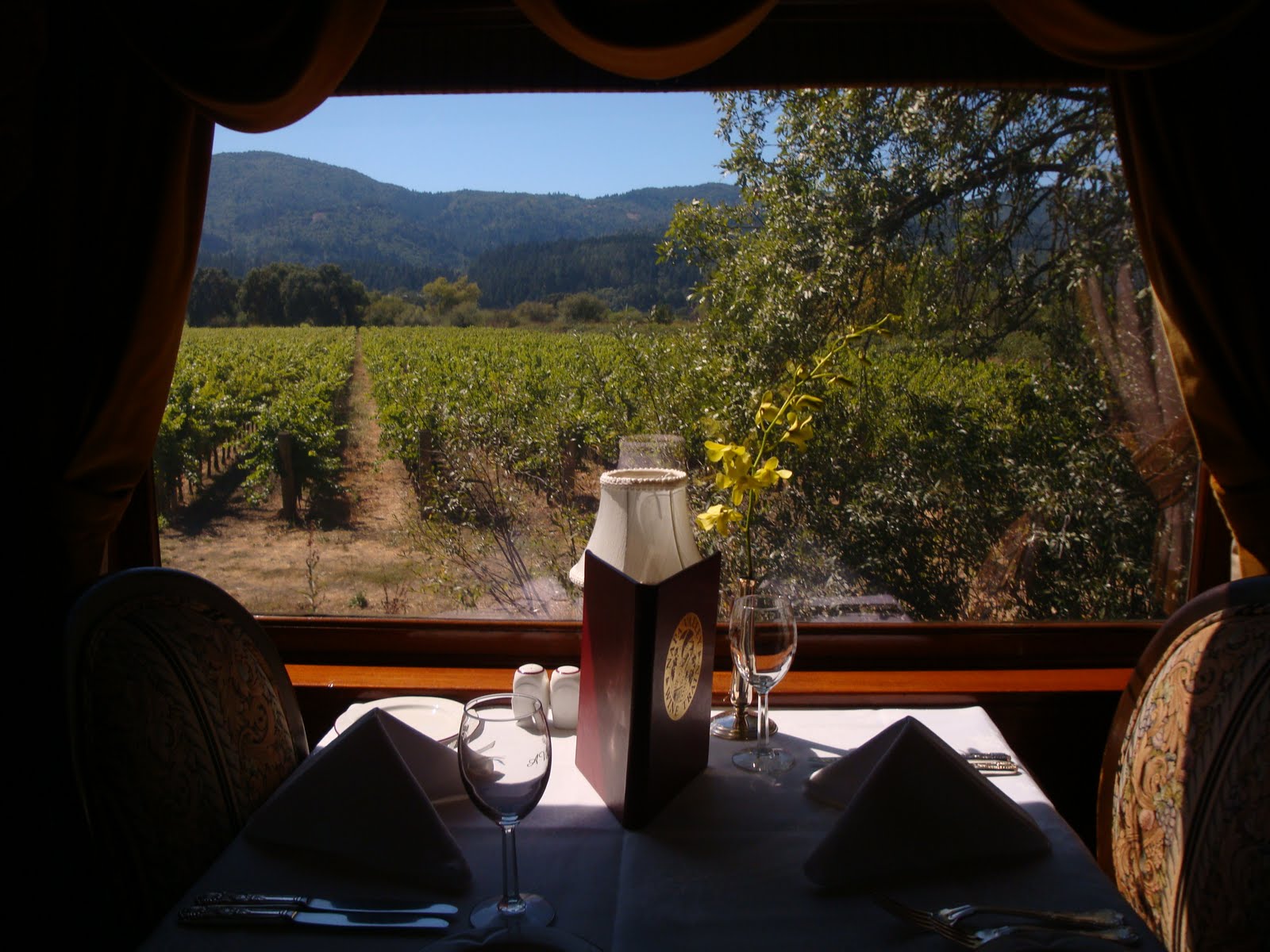
So here's what it's like to ride the Wine Train with Chris Phelps (left); I'll try to get off some lame one-liners anyway. All aboard!

10:45 a.m.: While waiting in the train station, we're all given tastes of two wines: a $12 Pinot Grigio and a $10 red blend. They're OK. There aren't any spittoons, but nobody spits while tasting on the Wine Train. The whole point is that you don't have to drive.

The Wine Train isn't really transportation, though. You go up to St. Helena, and then you turn around and come back; you get lunch (or dinner) along the way. There are a bewildering range of cruise-ship-like add-ons, such as winery tours by van. But I don't see why you would take them. It's pretty expensive to be on the Wine Train, and the view of the vineyards is good. So why take away from your time on board?

The crowd taking the train on a Friday morning is multiracial and multinational with a wide age range; the median is about 40. A Japanese bus tour takes the train; so does a video game company celebrating a product launch. Some people are talking about how they generally drink beer, but I overhear others talking about their previous visits to Napa Valley. I don't think this is a wine-geek party, but some people know more about wine than I expected.

Phelps tells the crowd about Swanson ("a small family-owned winery," neglecting to point out that the family made its money in frozen dinners) and talks about the crazy weather of 2010 ("It's a very Bordeaux year. I think we'll be able to pick at phenological ripeness at lower sugar. We'll have lower alcohol. In general I'm pretty excited.")

Phelps says his winery specializes in Pinot Grigio, unusual for Napa Valley, and Merlot. "Everybody loves Merlot, that's why you're here, right?"

A young game programmer says loudly, "Nobody loves Merlot."

When Phelps says they also make Cabernet, the programmer says, "Yay, Cabernet."

Graham tells us about the train, which train geeks will hate me for not knowing the details of. I know the track was laid in the 1850s, and the dining cars are restored Pullmans from the World War I era, and they're beautiful. One reason the train can't run lunch and dinner 7 days a week is that it needs a lot of down time for maintenance. "She needs to be treated like a dowager," he says.

11 a.m.: We board. This takes a while, as it's sort of like airplane boarding, by section. People on the train get their lunches at different times, have different tours, get on and off at different points. Continental Airlines would never be able to successfully manage all these agendas.

Graham says the well-oiled machine his organization has become results from treating its employees well. The captain of our car has been there since the beginning; 21 years now. Our server has worked there for 14 1/2 years.

I quickly see why they want longevity in employees, because carrying bowls of soup in a moving train is a skill.

11:30 a.m.: Lunch starts for us. Some people eat their apps in one car and move to another for their main. We're sitting with Phelps so we stay in one place the whole time.

Here's our menu:


Swanson Vineyards Napa Valley Pinot Grigio 2008
paired with
Watermelon and Mango Tuna Poke

Swanson Vineyards Oakville Chardonnay 2009
paired with
Fresh Monterey Bay Shrimp and Local Sweet Corn Soup

Swanson Vineyards Oakville Merlot 2006
paired with
Grilled Filet Mignon of Beef and Seared Foie Gras with a Zucchini Carpaccio

Chocolate Strawberry Cake
The tuna poke's good, and the Pinot Grigio is good with it. Macdonald had about a month to play around with the wines, and he says, "The Pinot Grigio was very straightforward. That's why I went with the wild flavors on the plate. If the wine is wild and busy, I have a little fat. I have the beef."

The second course is the highlight; the corn soup is amazing. Macdonald used some complicated technique wherein he milked the corn kernels and then soaked the cobs in the milk to extract more corn flavor, but I didn't get all the details because I was greedily eating it up. I hadn't even known Swanson made Chardonnay, and in fact it's only 300 cases for the tasting room. Very nice wine; good lemon fruit and balance.

Phelps had never made white wines before landing at Swanson in 2003. He's one of the foremost Merlot specialists in California, having interned at Chateau Petrus in Bordeaux before becoming winemaker at Dominus and then Caymus in Napa Valley, where he made only reds. He said whites were a challenge: "I thought it would be easy. There's a lot of subtlety involved. It took me a couple years." In fact, I've been tasting Swanson's Pinot Grigio for several years and have noticed an improvement; if you haven't tried it in awhile, give it another whirl.


The very rare filet seemed the biggest challenge in the kitchen, what with cooks trying to work beside each other in a space not much wider than a doorway, and all the usual physical hazards of a high-volume kitchen. Macdonald (right) told me Top Chef did an elimination challenge on the Wine Train, and that seems cruel, though if you can cook in that kitchen, you can cook anywhere.

While we're eating, we keep on rollin'. The train starts in an ugly industrial part of the city of Napa but soon enough you're right beside Highway 29, and the 10 feet or so elevation of the train gives you a great view in all directions. Phelps points out that beautiful red leaves in vineyards actually indicate a virus problem (and there's no Santa Claus either, spoilsport.) He's relieved when we pass Swanson that none of his coworkers is holding an embarrassing sign, as apparently happened on several of his other annual voyages.

I really enjoyed the '06 Swanson Merlot; well-balanced, good fruit, and a good match for the meat. After finishing my glass, I take a tour of the train and spot the young programmer who spoke out against Merlot. Phelps had earlier told me a story of converting a woman in a coffee shop by bringing her a glass, so I instigate -- why don't you bring this guy a glass? He goes to get one.

Meanwhile, I check out the tasting bar. Among your four tastes for $10, you could settle for Buehler White Zinfandel, but you could also have Heidi Peterson Barrett's 2009 La Sirena Moscato Real, Morgan Twain-Peterson's Bedrock Stellwagon Vineyard Zinfandel, or 2004 Pahlmeyer Chardonnay, and some other nuggets.

I like riding on the back of the train; passengers in cars on the neighboring Highway 29 wave at you and some take your photo. However, I wouldn't have enjoyed taking the cheap $49.50 ride-only fare, because that's in an open-air car, which is always risky with Napa Valley weather; hot in summer, cold in winter. It's better to have open air when you want it, and be able to go indoors when you need to. Also, if you're not going to eat, drink and luxuriate, why wouldn't you just drive up and down Highway 29 in your own car?

Here's my big finish: Phelps showed up in front of the programmer's group of friends with a glass of Merlot, which he dared him to try. Happy ending? Nope: the wine was "too sour," the programmer said.

One of his friends said, "I'll take it. I like Merlot." And he sipped it happily as the train chugged southward. Happy ending after all.

Monday, October 4, 2010

A Giant in winemaking: Jordan's Rob Davis

The San Francisco Giants are Northern California wine country's favorite team. So when they clinched their first division title in 7 years yesterday, cellar workers and winemakers paused briefly from an exhausting harvest weekend to high-five their sweaty, grape-stained hands.

Lots of winemakers like the Giants, but Rob Davis of Jordan Winery has a special relationship. Davis once called Giants announcer Mike Krukow on his cell phone during a World Series game -- and Krukow took the call! Of course, as you'll see below, there's some debate about whether that phone call or Robb Nen's fraying shoulder really cost the Giants that Series.

This post is a Q&A about Davis' Giant memories, but he's an amazing story on his own. On his 35th vintage, he's the only winemaker Jordan has ever had.

Tom and Sally Jordan struck it rich on an Indonesian oil find and bought the Alexander Valley estate. When they founded the winery in 1976, they asked Andre Tchelistcheff to be their winemaker. He said he was too busy, but said he would find them a good young winemaker and mentor him. Tchelistcheff went to UC Davis and met Rob Davis (no relation), who was tops in his class. Rob was hired for that first vintage and has been there ever since. And he's a triathlete who has so much energy he can barely stand still, so he might some day equal Tchelistcheff for total number of vintages.

John Jordan took over the estate from his parents' accountants five years ago, and would be happy if I told you about what Jordan's up to these days. It's no longer making purely estate Cabernet, but is selling estate fruit that doesn't meet its standards and buying fruit from its neighbors to try to make better wine. Jordan makes only two wines: a Cabernet Sauvignon and a Chardonnay, and while it has rarely gotten top ratings from certain national critics, it has long been a sommelier favorite because the winery actually believes in balance rather than just paying lipservice to it. The 2006 Jordan Cabernet I had last week had just 13.5% alcohol and was almost as tasty as the third-to-second double play Pablo Sandoval turned in the 6th inning yesterday (hey John, try that on a shelf talker).

Which brings me back to the Q&A. Here's Rob Davis on the Giants:

When did you first become a Giants fan?

My first audible memory was hearing my dad listen to the Giants on his transistor radio: Russ Hodges and Lon Simmons. But I probably became a Giant fan when I was playing Little League baseball. Our team went to Candlestick to watch the Giants play the Pittsburgh Pirates. Even as a kid, I remember Willie Mays running to make a basket catch. All of us who played the outfield in Little League tried to catch the ball like Willie. We discovered it was not an easy feat to do.

Was it like your first great bottle of wine -- did you have an "aha" moment?

My "aha" moment came much later when I was at Candlestick and the Giants were behind in a night game that was critical to their playoff hopes. Jack Clark ripped a rope over the left field wall to win it and everyone I was sitting next to starting high-fiving, hugging each other. I can still remember the sound of the ball off of his bat. Whack! One of the reasons why I advocate wooden bats over aluminum bats: the sound is so sweet. In that moment I realized how special an important event can be, shared with someone other than yourself.


Who was your first favorite Giant?

I loved watching Willie Mays (left). He wore a cap slightly larger than his head so when he ran down a fly ball, his hat would fly off, giving the perception of a great effort. He enjoyed the opportunity to entertain. As I came to appreciate the difficulty of playing in Candlestick with the wind and the cold, I marvel to this day at the incredible athleticism of Willie Mays.
But for my favorite Giant, I have to say Willie McCovey. The quiet grandeur and stature of the man epitomized the rarity of a great athlete who allowed his performance to call attention rather than his words. I still agonize over the frozen rope he hit to Bobby Richardson to make the last out of an incredible World Series with the Yankees. The fact that Bobby Richardson was playing out of position makes it even more difficult to accept.

Who's your favorite Giant now?

Buster Posey is the whole package: intelligent, patient at the plate, bats for power as well as average and has the aura of a player seasoned by many years, yet he is a rookie. His performance matches defense with offense. A consummate professional. Andre Torres would be a close second. I love speed in a baseball player: great fielder, fast on the bases and can hit for average as well as power. Right now he is having to make adjustments to the pitchers who have already made their adjustments to when he was hitting the cover off the ball.

What's the best memory you had at Candlestick?

So many. Sitting with my dad watching the game while he slowly chewed on black licorice. Watching Krukow win the 1987 playoff game with St. Louis. And of course watching Will Clark get his famous RBI hit with Kevin Mitchell on deck in the '89 playoff game with Chicago (off Mitch Williams), only to have that moment topped by sitting in Section 8 at Candlestick during Game 3 of the World Series when the earthquake hit.

What's the worst memory you have of a Giants game?

That's easy: 2002 when the Giants lost game 6 of the World Series with the Angels after having a 5-0 lead. My stomach still aches from that one.

You're friends with Mike Krukow -- tell us a Krukow story.

Courtesy CSN Bay Area
As we all know the 2002 World Series featured the Giants and the Angels and was played during harvest. When I got home Game 6 was still playing and when my wife told me the score, 5-0, with (Russ) Ortiz pitching well, I finally allowed myself to get really excited. After all, I had been waiting since 1962 for the Giants to be this close to a World Series win.
I had the pleasure of dining with Peter Magowan at the winery and he shared his determination and wish that he could bring a World Series win to San Francisco. Many of the players -- Shawn Estes, Robb Nen, Armando Rios, Rich Aurilia, their trainer Stan Conte, along with their wives -- had visited the winery in 2001. So I filled a glass with wine and took it up the hill to listen to the broadcast.
I called Krukow on his cell figuring that I would get his voice mail since he was broadcasting, and to my surprise he answers. We both are all jazzed and when I hang up, I walk back down to my house to watch the rest of the game on TV.
To my amazement, I see Dusty Baker walk to the mound to take Ortiz out. I knew the relievers were exhausted and Nen was pitching on sheer guts since his arm no longer had the ability to deliver the fast sinkerball that he was known for. Also I knew the umpires were making the strike zone incredibly small, which caused the high scoring games. Ortiz was on top of his form.
We all know the results. Tim Worrell, Felix (Rodriguez) and Nen couldn't hold back the Angels and the Giants lost by one run...and that was the Series.
I couldn't believe how much that game affected me. Bart Giamatti is right: it is a game designed to break your heart. And yet we return in the spring to renew our faith once again.
Krukow called me during the Christmas break; said he wasn't blaming me for the loss (baseball tends to have many superstitions, my call being a possible cause of the Giants downfall that game). I thanked him, wished him a merry Christmas, and then my stomach started to ache all over again.

How many Giants have you shared a bottle of Jordan wine with?

It is always a surprise for me to hook up with a baseball player that is so fond of wine. Rollie Fingers dropped in during a harvest and I wanted to meet him but I had a load of fruit show up. So I asked him if he wanted to help me sort fruit on our conveyor. He and his wife jumped at the opportunity. We all had a blast.
Of course Krukow is a big fan and I helped him with a bit of his homemade Pinot Noir. He actually is quite adept at making wine. His first wine, a Zinfandel, was sensational.
Tom Glavine of the Braves visited the winery and shared his approach to pitching the first few innings. Rich Aurilia is quite the wine fan. Orel Hershiser loves wine, especially Cabernet: really nice guy, even for an ex-Dodger. Ernie Banks and I shared a glass at dinner in Chicago. His most feared pitcher: Bob Gibson. Ozzie Smith is also a big wine fan. But my lasting relationship with Mike Krukow is very special. I really enjoy dropping in on he and Duane Kuiper in the broadcast booth before the game. Their enthusiasm and knowledge of the game is absolutely infectious.

October is your busiest month of the year. What's the strangest place you remember watching or listening to a Giants playoff game?

After the earthquake of 1989 that disrupted the World Series schedule, the remaining games ended up pitting the two best Oakland A's pitchers against the two best Giants pitchers, so the depth of the squad wasn't really exercised. With the A's up 2 games already, they won the third under a rested Dave Stewart and I watched the final out at Rusty Staub's on Fifth, in New York City, after pouring our wine at the Wine Experience Event. Katie Wetzel of Alexander Valley Vineyards was with me. She is a huge fan. She cried at the last out. I'm thinking, "How did I end up here to watch the Giants lose the World Series after sitting in the stands a few weeks ago?"

If I had 2 good seats to the World Series, say Club Level infield, how many bottles of what vintages would you trade me? (Note: this is a theoretical question; my World Series tix are on my couch in front of the TV.)

I buy a case of our wine each year specifically to give as gifts to my friends or people who are big fans. I remember receiving a really nice birth announcement from a guy who liked our wine and wanted to name her daughter "Jordan." She was born in 1976. I kept the announcement and as the years quickly passed, I came across it and to my surprise saw that her 21st birthday was coming up: 1997. So I hoped that her folks' address had not changed and sent her a bottle of '76 from my personal cellar. Her thank-you note was so precious. And now I find friends of my daughter whose birth year coincides with an older vintage of Jordan from my cellar and I enjoy giving it freely without charge.
I think it is better to give the wine to someone than sell it or drink it. So if you had 2 really nice seats to the World Series, I would try to purchase them. But if you have a special year that I have in my cellar, I would just give you the bottle. We both would enjoy it more that way. Unfortunately my cellar has shrunk to where I have less wine to offer.

Let's torture an analogy. The Giants are like Jordan wine because ....

They swing for the fences and clear it easily.

Follow me on Twitter: @wblakegray and like The Gray Report on Facebook.